
Katherine Bernhardt "Fun Things We Like" Canvas Bag Project
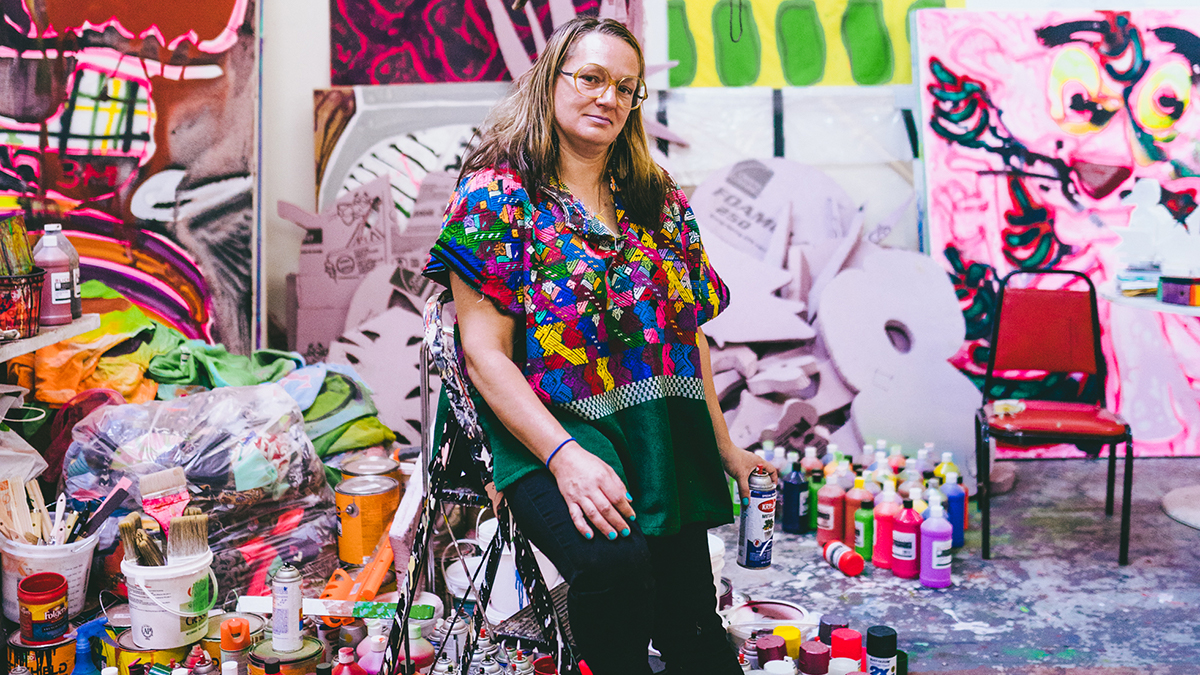
Katherine Bernhardt (born 1975; Clayton, Missouri) is an artist based in St. Louis, Missouri.Bernhardt received her MFA from the School of Visual Arts, New York, and her Bachelor of Fine Arts (BFA) from the School of the Art Institute of Chicago, Illinois. Her boundless visual appetite has established her as one of the most energetic painters working today. Her trust in the fundamental underpinnings of painting gives her the freedom to depict anything she wants, and the democratizing surfaces of her canvases work without illusion, perspective, logical scale shifts, or atmosphere.
Today we're going to think about "Fun Things We Like" and paint them on canvas bags inspired by Katherine Bernhardt.
Let's take a look at some of her work:


Katherine Bernhardt, Sharpies on Black, 2014, 96 × 120 in (243.84 × 304.8 cm)
Acrylic and spray paint on canvas
96 × 120 in (243.84 × 304.8 cm)
Acrylic and spray paint on canvas
Objective:
• Students will learn about the life and work of contemporary artist Katherine Bernhardt.
• Students will understand her style, including her use of bright colors and everyday objects as subjects.
• Students will create their own artwork inspired by Bernhardt’s style.
Materials Needed:
- Canvas bag
- Paint markers or Paint Sticks
- Card Stock
- Pencil
Introduction (10 minutes):
1. Introduce Katherine Bernhardt:
Show students this video on Bernhardts Work
https://www.youtube.com/watch?v=iLToFAQ57Go&t=262s
• Show students an image of one of Katherine Bernhardt’s colorful works (e.g., a painting of a banana, a cat, or a bottle of perfume). Explain that Katherine is a modern artist from the United States who loves using bold colors and fun objects in her artwork.
• Tell students that she often paints things we see every day, like food, animals, and toys, but she paints them in a big, fun way with bright colors.
2. Discussion:
• Ask students what kinds of objects they see in Bernhardt’s paintings. (e.g., bananas, cats, cans of soup)
• Discuss how her art is simple but very bright and colorful. Ask, “Why do you think she uses so many colors in her paintings?” Encourage students to think about how the colors make the objects look exciting or happy.
Main Activity (40-50 min):
- Hand out Canvas Bags, card stock, and paint markers (3rd-6th) or paint sticks (Tk-2nd).

- For TK-2nd grade have students choose one object to draw. For 3rd-6th Grade have students choose two objects to draw (they could be a food, toy, animal, or anything they like).
- Have the students place the card stock into their bags. Use a pencil to trace the card stock to create a border for the drawing. leave the card stock in the bag to prevent bleed through of the markers and paint sticks.

- Next have the students sketch their drawings. For TK-2nd grade have the students draw their object of choice at least 2 times and emphasize that the objects should fill up the space. For 3rd-6th grade have the students choose one object as their main object and one as their secondary object. Have them draw the main object large in the middle of the rectangle. Then have the students draw the second object multiple times around the main object. Encourage students to make the object look big and fun, just like Katherine Bernhardt does.

TK-2nd grade example 
3rd-6th grade example - Once the students have completed their sketches. Have the students use the paint sticks or paint markers to color in their drawings. Remind the students to color the entire rectangle and that the outlines in her artwork are created with colors other than black. They should try to make their artwork feel happy and bright, like a piece of Bernhardt’s work.

TK-2nd grade example 
TK-2nd grade example 
3rd-6th grade example 
3rd-6th grade example - Have Students write their first name and last initial in the bottom right hand corner.
- We will be displaying the bags at open house. So please collect the bags and store them in the computer lab. *Please place a sheet of paper between each bag when collecting. Thank you for all your hard work this year!


Extension (Optional):
• Art History Connection: You can show a short video or a few slides about how contemporary artists like Katherine Bernhardt use everyday objects to tell stories or make people feel something new about the world around them.
• Art Gallery Walk: Display all the students’ works on a bulletin board or along the classroom walls to create a mini art gallery. Have students walk around and look at each other’s art, noting how everyone made different choices but all used bright colors and fun shapes.
Key Vocabulary:
• Artist: A person who creates art.
• Contemporary Art: Art made in the present time (not from the past).
• Bold: Strong and bright in color.
• Pattern: A repeated design or shape.
• Shapes: Forms like circles, squares, and triangles used in art.
By the end of this lesson, students will have a basic understanding of Katherine Bernhardt’s unique style and will be able to create their own artwork inspired by her use of bright colors and playful subjects.